
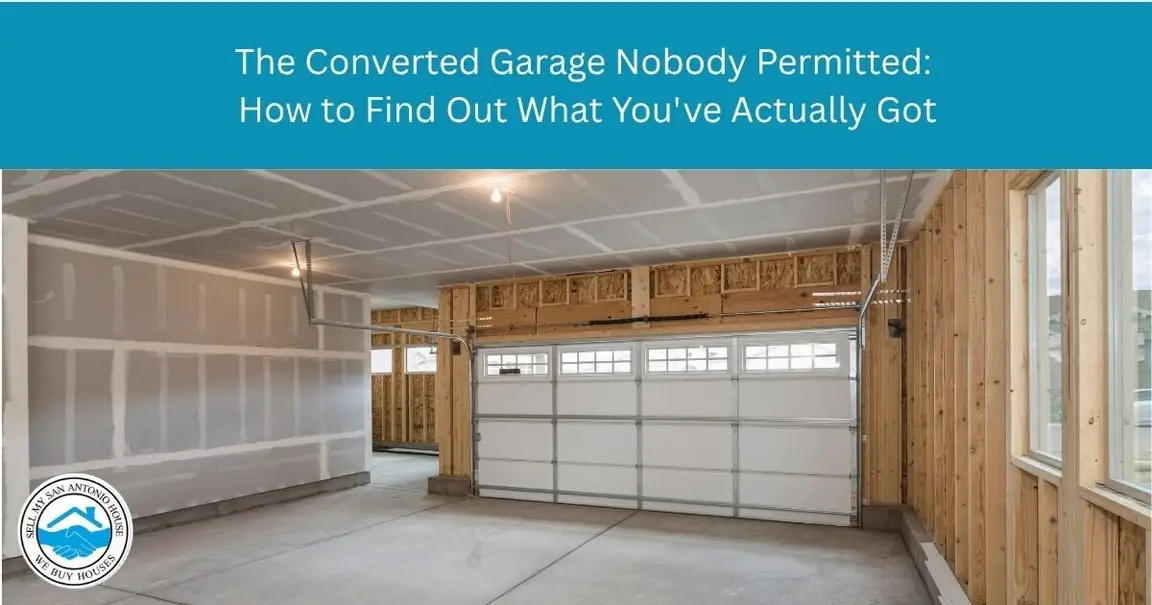
How many bedrooms does your house have?
Now go look up what Bexar County thinks it has. If those two numbers don’t match, you have something to sort out before you list, and it’s better to find it yourself than to have a buyer’s appraiser find it in week three.
Nick Disney here. I’ve walked through a lot of San Antonio houses with a bedroom that doesn’t appear on any record anywhere. Usually it’s a garage. Sometimes a carport that got walls, or a back porch that became a den in 1987 and nobody thought twice about it. The work is often fine. The paperwork is the problem.
By the end of this you’ll know exactly what to look up and what the answer means.
Start With Two Numbers
The first is what you’d tell somebody at a party. Three bedrooms, two baths, about seventeen hundred square feet.
The second is what the Bexar Appraisal District has on file. Look your address up on the appraisal district’s property search and find the improvement details — living area, room count, year built, recorded additions.
If your house has 1,700 square feet and the county says 1,320, that 380-square-foot difference is almost certainly the converted garage. That gap is the single most common tell, and it’s the reason the mismatch usually surfaces at appraisal rather than at listing.
Why is the county’s number off? Appraisal districts build records largely from permits and aerial photography. A conversion done entirely inside an existing footprint — walls already there, roofline unchanged — is nearly invisible from the air and leaves no permit trail. So it never gets added.
Then Pull the Permit History
San Antonio’s permit records are public and free. The city runs its permitting through a system called BuildSA, and you can search permits by address through the Development Services Department. The city also publishes a building permit dataset on its open data portal, which you can filter and download.
You’re looking for anything matching the work: a residential alteration, an addition, electrical or mechanical trade permits around the right year, and whether inspections were finaled or the permit was left open.
Two caveats matter here, and most articles skip both.
First, an open permit is its own problem. A permit that was pulled and never finaled can hang on a property for decades. It’s a different issue than unpermitted work and it can be easier to resolve, but it will surface at the same moment.
Second, and more important: if the work is old, missing records don’t prove anything. Digital records don’t go back forever. A 1987 conversion may well have been permitted properly, with the paperwork in a file nobody ever scanned. Absence of a record is a reason to ask questions, not a verdict.
And if your property is in unincorporated Bexar County rather than inside San Antonio city limits, the city’s records won’t have it at all — different jurisdiction, different rules about what needed a permit in the first place.
A Gap in the Records Isn’t Proof of Anything
If your square footage doesn’t match and you find no permits, there are three real possibilities.
The work was permitted and the record isn’t digitized. The work never needed a permit under the rules in effect at the time. Or the work was done without a permit that was required.
Only the third is a problem — and even then it’s usually a paperwork issue rather than an open code violation. You often can’t tell which you’re in without asking the city about your address. Call Development Services before concluding anything. It’s free, they deal with this constantly, and finding out on your own schedule beats finding out during somebody’s option period.
If your house also sits in a historic district, add a second layer — exterior changes there needed preservation approval on top of a building permit, and that’s a separate record to check.
Will It Actually Kill a Financed Sale?
This is where most advice gets it wrong in both directions, so here’s the honest version.
Fannie Mae does not automatically disqualify a property with an unpermitted addition. Its guidance requires the appraiser to comment on the quality and appearance of the work and assess what it does to market value. That’s a judgment call, not a disqualification.
But if the appraiser gives that square footage value, the guidance expects them to show the market accepts it — using comparable sales with similar additions. That’s hard, because no listing agent advertises “unpermitted addition” in the MLS. The comps you’d need are exactly the ones that don’t identify themselves.
On top of that, individual lenders layer stricter rules of their own. Plenty instruct appraisers not to count unpermitted square footage at all, whatever the national guidance says.
So the practical answer is: it’s not a rule, it’s a lender-by-lender coin flip. And that uncertainty is itself the problem. You can be under contract for three weeks with a buyer whose lender then decides your 380 square feet are worth nothing, which changes what the house appraises for and blows up the financing.
What Bringing It Into Compliance Involves
If the work genuinely was unpermitted and you want to fix it, understand what you’re signing up for.
An after-the-fact permit generally means the city has to inspect work now hidden behind finished walls. That can mean opening things up. The work has to satisfy code — electrical, an egress window in any room you’re calling a bedroom, ceiling height, heating and cooling. Structural changes may need an engineer’s letter. Older conversions frequently fail on egress and electrical, and that’s where the cost lands.
None of it is fast, and none of it is certain until an inspector has looked.
One thing you should not do is hide it. The standard Texas seller’s disclosure asks directly about additions or alterations made without required permits. Answering that dishonestly is how a closing dies at the last minute and how a seller ends up with a problem much larger than a permit.
One South Side House Nobody Thought Was Worth Saving
Ms. Hartin owned a property on Congress Street. It was in rough shape with title issues underneath it, and she had reached the point of believing the place might simply have to come down.
It didn’t. The house got repaired and sold.
I mention her because the instinct that a property is beyond saving is almost always wrong — and especially wrong when the real problem turns out to be records rather than structure. Paperwork problems look terminal right up until somebody who’s seen them before takes a look.
What Comes Up Once You’ve Looked
Q: My square footage doesn’t match the county’s. Do I owe back taxes on the difference? A: Possibly, if the appraisal district reassesses to include it. Ask them directly rather than guessing — the amount depends on the value added and how far back they go.
Q: The previous owner did the work. Am I responsible? A: For selling purposes, yes. Compliance attaches to the property, not to whoever did it. You inherited the situation along with the house.
Q: Can I just take the extra room out of the listing and sell it as a two-bedroom? A: You can, and sometimes that’s the cleanest path. You’ll price to a smaller house, and you still have to disclose what’s there.
Q: Is it cheaper to permit it or to sell as-is? A: Depends entirely on what the inspection finds, which nobody knows before it happens. Get the city’s read on your address first — that’s the cheapest information you’ll buy in this whole process.
Q: Does an unpermitted garage conversion affect my insurance? A: It can. Ask your carrier, especially if a claim would involve that part of the house. This is worth a phone call now, not after something happens.
Q: What if I find an open permit from fifteen years ago? A: Call Development Services and ask what closing it out requires. Sometimes it’s a final inspection and a small fee. Sometimes it’s more. Either way it’s fixable and it’s better handled before you list.
Here’s your task, and it should take under an hour.
Look up your square footage at the Bexar Appraisal District. Search your address in the city’s permit records. Write down the gaps. Then call Development Services and ask what your specific address needs.
You’ll either find there’s nothing to worry about, or you’ll find out on a Tuesday afternoon instead of during a buyer’s option period. Both are good outcomes.
And if what you find is bigger than you want to take on, we’ll look at the house exactly as it stands, converted garage and all, or call (210) 201-6644.
Anti-Sameness Check vs. Posts 1–4 (§0.8)
| Check | Result |
|---|---|
| Shared H2 headings | None |
| Shared FAQ questions | None (0 of 6) |
| Shared 6-word phrases | 0 |
| Opening type | P1 scene · P2 number · P3 direct address · P4 news lede · P5 direct question. All different. |
| Structure | Diagnostic — the only post so far organized around a lookup procedure. |
| Case study heading | Posts 1 and 3 both used “What This Looked Like for…” — that pattern is now retired. This one uses “One South Side House Nobody Thought Was Worth Saving.” |
| Author credential line | Fifth distinct phrasing: “Nick Disney here. I’ve walked through a lot of San Antonio houses with a bedroom that doesn’t appear on any record anywhere.” Leads with experience instead of a founding date. |